I came across this story on social media recently and the headline caught my attention so much I had to do my own research.
It’s the story of an American teacher called Ronald Sakolsky, a Chinese farmer called Yin Yuzhen, and a $5,000 donation which, almost three decades later, has helped contribute to a remarkable transformation of the landscape in one of China’s desert regions.
At White Mosaic, we’re naturally interested in landscape, ecology and the way that planting can change an environment over time, so we found it particularly fascinating!
How a television programme led to a $5,000 donation
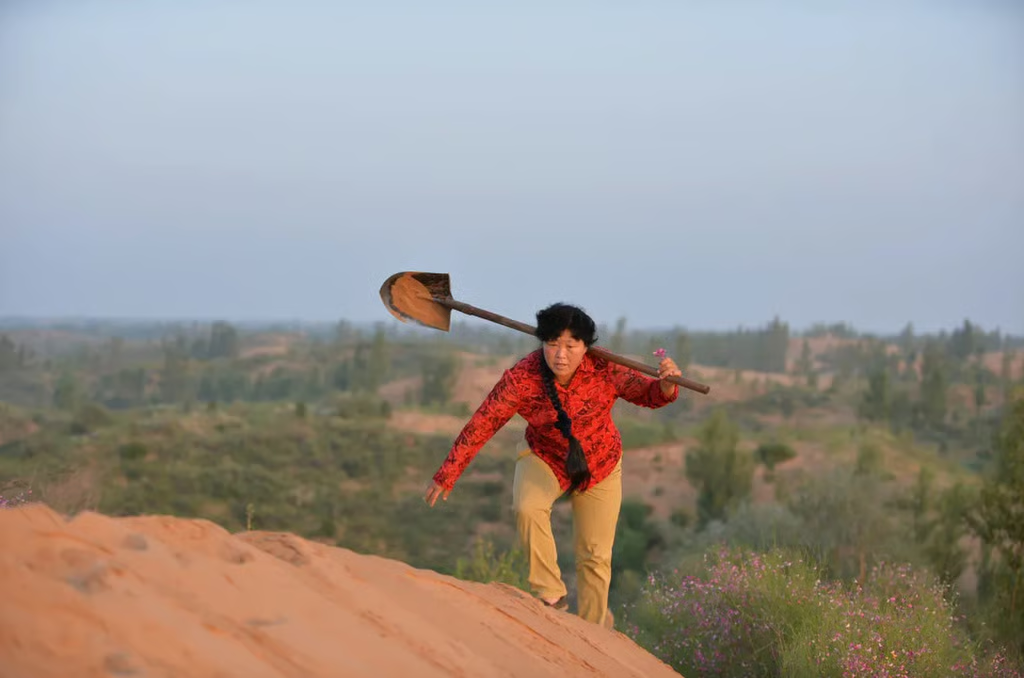
Back in 1999, Ronald Sakolsky was working as an English teacher in Luoyang, in China’s Henan Province. One evening he watched a television programme about Yin Yuzhen, a woman living in the Mu Us sandy region of Inner Mongolia who had spent years trying to combat desertification by planting trees.
The landscape she was working in was incredibly challenging. The area had been severely affected by desertification, with vast expanses of sand and very little vegetation able to survive. Yin and her husband had begun planting trees in an attempt to stabilise the land and create a more hospitable environment, but this was hardly conventional gardening. Trees were difficult to establish, water was scarce and many of the early plantings failed.
What struck Sakolsky was the determination behind it. Here was somebody working away, year after year, trying to change an environment that must at times have seemed almost impossible to change. Although he was on the other side of the world, he decided he wanted to help.
He began contacting organisations in the United States to see whether he could raise some money for Yin’s work and eventually secured a donation of $5,000. It may not sound like a particularly large amount of money when compared with the budgets attached to modern environmental restoration or large-scale landscape projects, but in this case it was enough to buy thousands of tree seedlings.
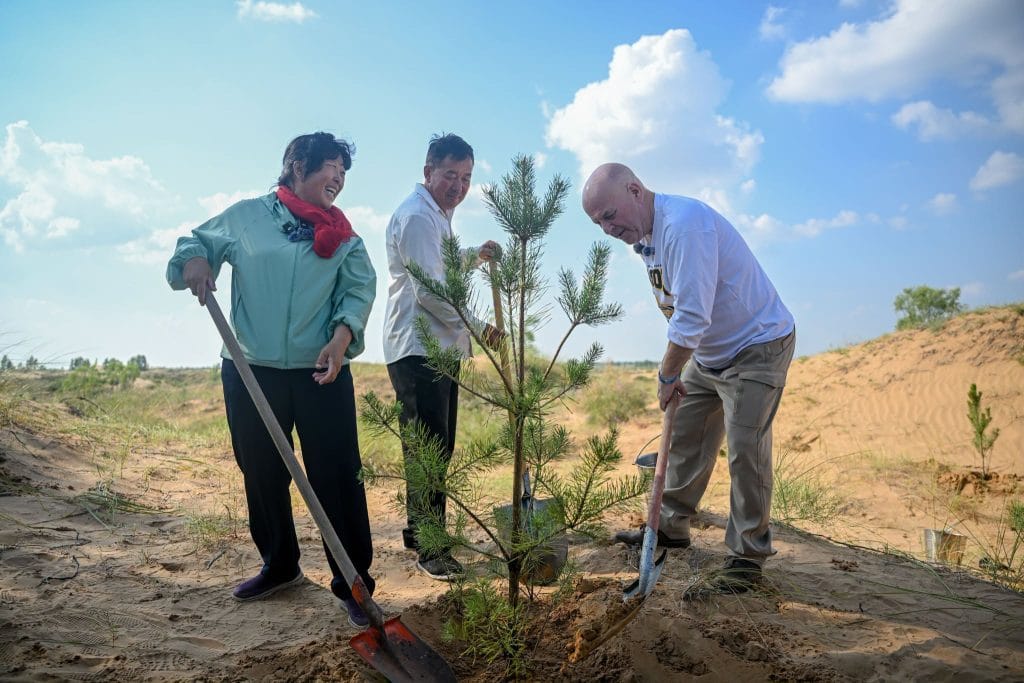
Sakolsky sent the money to China, and Yin used it to purchase and plant saplings. When he eventually travelled to China himself in 2000, he was able to see the project first-hand and meet Yin. At that point, however, neither of them could have known quite where the story would lead.
From planting trees to transforming a landscape
They eventually lost touch, and for more than two decades their lives continued separately. Yin, however, carried on planting and expanding her work. The trees grew, the landscape gradually changed and what had begun as a relatively small planting project became part of a much larger effort to restore an environment affected by desertification.
According to recent reports, more than 50,000 trees connected with the project have now grown, while the wider area of restored vegetation has expanded across thousands of hectares. An area that had once been desert has gradually become a much greener landscape, with trees and vegetation creating new habitats and helping to support a very different ecological environment.
Then, rather wonderfully, the story came full circle.
After 27 years, Yin began looking for the American teacher who had helped her all those years ago. Through social media and the efforts of people who had heard the story, Sakolsky was eventually found and the pair were reunited by video call. He subsequently returned to China to see the landscape again for himself after so many years!
What happens when you give a landscape time?
If you plant a tree in a landscape today, it can be surprisingly difficult to imagine what that same place might look like in 10, 20 or 30 years. A small tree can seem almost insignificant when it is first planted, particularly within a large site, but given the right conditions and enough time, those individual trees can begin to influence an entire landscape.
That is true whether you are looking at a huge environmental restoration project or a much smaller piece of designed landscape. Planting is not simply about what something looks like when it is finished. Trees and other vegetation become part of a living system, providing habitat, food and shelter. Over time, the landscape itself begins to evolve.
It is also why I think there is an interesting connection between stories like this and the growing interest in rewilding, ecological landscape design and biodiversity-led development. We are increasingly thinking about landscapes not simply as decorative spaces, but as functioning ecosystems that can provide environmental benefits as well as being beautiful and enjoyable places for people.
The bigger picture: ecology, biodiversity and rewilding
Of course, nobody would suggest that one $5,000 donation solved the problem of desertification in China. What makes the story so interesting is something much simpler: one person saw somebody doing something extraordinary for their environment and decided to help.
Environmental restoration can seem like an enormous task when viewed on a global scale, particularly when we think about issues such as climate change. But landscapes are ultimately changed through individual actions. Trees are planted, habitats are created, soil is improved and ecosystems are given the opportunity to recover.
A reminder that landscapes are always changing
Ronald Sakolsky probably had no idea what his $5,000 would eventually contribute to when he watched that television programme in 1999. Almost 30 years later, however, the result is a landscape containing tens of thousands of trees, and a rather wonderful reminder that good things in ecology and landscape often take patience.
We tend to judge landscapes by what we can see today, but the best landscapes are often about what they will become. And sometimes, as the story of Ronald Sakolsky shows, it takes somebody with the foresight to plant that first tree and give it the chance to grow.